“Maintaining Sharp Focus on A Grainy Film” – TL;DR

There are some phrases completely unknown to the general public that medical professionals would instantly recognize.  One of them is “miliary pattern,” which has essentially become a euphemism for disseminated TB.  But the miliary pattern that is seen on chest x-rays and CT scans is not synonymous with disseminated tuberculosis.  Instead, it can be seen in plenty of other situations, like the one we describe in this article, published in the BMJ Case Reports.

This article has actually been in publication-purgatory for about a year or so, but I’m glad that it’s finally out in print.

American Graffiti, Iowa Style

Yes, it has been a while since I updated the website but that’s because I’ve been on call.

When I haven’t been cloistered in the hospital or clinic seeing interesting cases, I’ve been outdoors because the weather in Iowa has been absolutely wonderful.

I ran into this piece of uplifting graffiti the other day, which had a pretty straightforward message.  But I guess that’s Iowa for you.

IMG_1353


There’ll be more posts soon once I get off call.  In the meantime, I’ll gladly take the advice of this unknown midwestern graffiti artist.


Sneak Peak: Anton Chekhov’s Case Report

Things are rather humdrum here in Iowa, not that I’m complaining.  Life continues, with new colleagues, new challenges, and new clinical responsibilities as a second year fellow.

Fotunately, in the past few days, because of the lull in activity, I have had a chance to write.  Without giving too much away, I would like to provide a sneak peak for the next essay I intend on drafting:

There are few physicians who have read the works of Anton Chekhov.  Even fewer have heard of his gun.  But still, Checkhov’s gun hangs unobstrusively in the background of every case report in medical literature today, waiting patiently to be discharged at a moment’s notice.  It can be considered both the greatest strength of the modern case report, as well as its most notable bane.  To those who do not know, …

Well, that’s how it starts.  I’m not sure how it will end though, but I suppose that is the fun of writing.

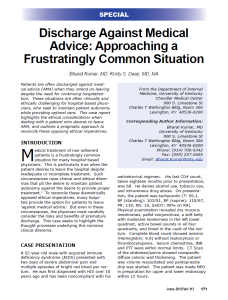
“Discharge Against Medical Advice” – TL;DR

It’s perhaps a little late, but I would like to establish a new feature here on the blog, a TL;DR section for recently published articles.  To those who don’t know, “TL;DR” stands for “Too Long: Didn’t Read.”  In internet-speak, It’s a one or two sentence summary of a story that is worth communicating but whose length may be too intimidating for casual readers.

So here is my first TL;DR (courtesy of twitter):

If you want to read the full article, it can be found here, or on the website of the Journal of the Kentucky Medical Association.

DAMA

The article, though not in the most prestigious or noteworthy of journals, has a very sentimental place in my heart.  It is likely the last manuscript on which I can legitimately write that I am a resident at the University of Kentucky.  Quite fittingly, it also happens to be featured as a special in the last ever issue of the Journal of the Kentucky Medical Association.  C’est la vie, I suppose.

A Year After Kentucky

I didn’t think I would ever live in Kentucky.  But once I was there, I didn’t think I’d ever leave.

When most folks hear about Kentucky, they don’t have the most flattering images in their minds.  A common stereotype is of the slack-jawed yokel wearing overalls doing some sort of drunken jig while taking a swill from a jug that is cryptically labelled XXX.  But this pre-conception is not only highly offensive but is completely inaccurate.  Kentucky is home to a tremendously diverse set of people, and only a few of whom very vaguely resemble the pernicious stereotypes that we see on television.

Yes, it is true: in my three years in Kentucky, I did see a lot of poverty, a ton of obesity, and a soul-crushingly high rate of drug addiction (including alcoholism and tobacco abuse).  But what I observed most keenly was the warmth of the average Kentuckian.  Maybe I was naive, or looking to confirm my own optimistic biases, but I had a sensation that when people asked you, “how are you?” it was more than just a formality.  There didn’t seem to be any agenda on their ends: only an altruistic consideration.  Without delving into the other end of unfair stereotypes (i.e. undeservingly positive ones), I found their mindset to be very life-affirming – and I’ve worked hard to adopt it.

I didn’t expect to be so touched by this sincerity.  But I was.  And even though Iowans have their own particular style of homespun authenticity, I truly miss the southern hospitality and altruism that fundamentally define the identity of the Commonwealth of Kentucky.

Having only lived there for three years, I wholeheartedly admit that I am not an authentic “born and breaded” Kentuckian.  But I would like to believe that regardless of whichever state I may physically be in, I will always continue to carry that spirit of Kentucky with me.