All posts by Bharat

Leadership Means Being At Our Personal Best

IMG_2384

A stream originating from hot springs in Suðurland (South Iceland)

First and foremost, leadership does not depend on being the first, the biggest, or the richest.  For most of its history, Iceland has been a rather scraggly country on the westernmost fringe of Europe.  Even in this day and age, for most people, it’s an afterthought: a place of interest that only rarely comes to the forefront barring a geologic or financial catastrophe.

Iceland has not sent a man to the moon, nor has a military of significant size, nor even a soft power that it can project upon others.  But it nevertheless exerts leadership, because Iceland has made the best out of its limited resources.

Through democracy (Iceland’s althing being the world’s oldest existent Parliament), work ethic, and generous financial assistance through the Marshall program, Iceland has been able to capitalize on the intelligence and diligence of its people, and ensures that even though it may not necessarily be at the front of the pack, people look at Iceland with a degree of regard and respect and, to a great extent, wish to emulate.

It seems like a generic observation, but our lives are defined by competition to be the most, the first, or the biggest.  And that’s important but that’s not necessarily what leadership is about.  Leadership, as far as I see it, is about being at one’s own personal best so that one can affect a change in the world.  And that self-confidence to translate personal potential into action, in turn, can prompt us to be leaders at the forefront as the biggest, the best, the first, etc.

I’m back

IMG_2873 (1)

I can’t help but apologize for the lengthy delay in getting back to the blog. Fellowship and all the other things that make life so hectic certainly do squeeze out time for blogging. Besides that, a lot of things have occurred in the past two months. One of the more eventful things has been my very recent vacation to Iceland.

It was absolutely breathtaking, and I hope to share some photos and experiences with you soon. While I was there, I had a chance to just ruminate (or,rheuminate, if you will) about leadership, a topic that I’ve been thinking a lot about over the past few weeks. Perhaps it was just because I was away from my desk, but over that week, I saw many different examples of leadership principles that I have been casually reading about.

In fact, I noticed seven overarching themes about leadership during my time there, which will be forthcoming in seven short individual posts, with a few pictures interspersed.

Rheumatic Diseases aren’t just First World Problems – a TL;DR

Last night, I took a long walk to clear my mind and gazed up at the night sky. On this moonless night, I saw the Milky Way in all its glory, something I only rarely get to appreciate nowadays. Seeing Orion, the Big Dipper, and the other constellations triggered some very fond memories of family vacations that we spent in India. I remember my grandfather pointing above to connect the dots and telling me the mythic stories of how they came to be in their positions in the night sky.

It also reminded me about how small our world is. The same stars that I viewed from the foothills of the Himalayas twenty-some-odd years ago are the same ones I can see from the plains of Midwestern America. And the same diseases that I see in clinic – Rheumatoid Arthritis and Systemic Lupus Erythematosus to name just two – are the same that afflict those throughout India and the third world.

But for some reason, we completely forget about those in the developing world who have these diseases. For some reason, we think that only the immune systems of those people in the First World are susceptible to dysregulation, and that, because we have effective treatments to induce remission in many of these patients, that poorly controlled disease is a thing of the past.

It’s not. The agents we use to induce remission are largely either unavailable or inappropriate in large swathes of the developing world. It’s unreasonable to use some of our potent immunosuppressants in areas where latent tuberculosis is rife. Monitoring for toxicity is often impossible, and so patients are left to suffer on their own.

This editorial is meant to help bring these issues to the forefront, and to highlight that our work, as rheumatologists and rheumatologists-in-training, is far from done. Immunologic and musculoskeletal diseases bear a disproportionately high rate of morbidity in these areas. It’s easy to get caught up in the excitement of new medications and diagnostic techniques, but we must never forget that we are also obligated to treat those with the greatest need.

Risking Life and Limb: A TL;DR

My last case report from Kentucky has finally come out.  You can find it in the Journal of General Internal Medicine (currently e-published nbut will be in print soon). It’s bitter-sweet: it marks the end of an unbelievably academic productive era.

There aren’t any spoilers in this case report – the title says it all.   While deep vein thromboses (clots in the legs) and cellulitis are common causes of leg pain in diabetic patients, physicians should consider diabetic muscle infarction, also called diabetic myonecrosis.  Making the diagnosis makes a huge difference in treatment, especially in directing physical therapy.


The Physical Exam’s only as Good as the Examiner: a TL;DR

My second column in The Rheumatologist has just come out.  Don’t let the incredibly boring title fool you; it’s been generating some buzz, at least on social media (I think).  If you want to take a read, here’s the link: Rheumatology Fellow Questions Diagnostic Utility of the Patient Physical Exam.  And if you don’t have time, here’s the short version below.

TL;DR – “Ultimately, the relevance of the physical examination depends on whether we apply the right test at the right time for the right patient. If we treat it perfunctorily as a ritual or gesture, then we take away its significance, and might as well save time and skip it entirely.”

Seven Tips for New Rheumatology Fellows: A TL;DR

TL;DR – “Fellowship is more than just a continuation of residency. It’s as drastic a change as the transition from medical school to internship.”

I apologize for neglecting the blog.  I kind of expected that as things ramp up this year with more calls and conferences, that posts would get fewer and far between.  But I didn’t expect it to fall off so quickly.

The biggest news in the past week is that I’ve published my first column in The Rheumatologist.  Head on over to read a practical piece for new Rheumatology fellows, entitled “Seven Tips for New Rheumatology Fellows.”

“Maintaining Sharp Focus on A Grainy Film” – TL;DR

There are some phrases completely unknown to the general public that medical professionals would instantly recognize.  One of them is “miliary pattern,” which has essentially become a euphemism for disseminated TB.  But the miliary pattern that is seen on chest x-rays and CT scans is not synonymous with disseminated tuberculosis.  Instead, it can be seen in plenty of other situations, like the one we describe in this article, published in the BMJ Case Reports.

This article has actually been in publication-purgatory for about a year or so, but I’m glad that it’s finally out in print.

American Graffiti, Iowa Style

Yes, it has been a while since I updated the website but that’s because I’ve been on call.

When I haven’t been cloistered in the hospital or clinic seeing interesting cases, I’ve been outdoors because the weather in Iowa has been absolutely wonderful.

I ran into this piece of uplifting graffiti the other day, which had a pretty straightforward message.  But I guess that’s Iowa for you.

IMG_1353


There’ll be more posts soon once I get off call.  In the meantime, I’ll gladly take the advice of this unknown midwestern graffiti artist.


Sneak Peak: Anton Chekhov’s Case Report

Things are rather humdrum here in Iowa, not that I’m complaining.  Life continues, with new colleagues, new challenges, and new clinical responsibilities as a second year fellow.

Fotunately, in the past few days, because of the lull in activity, I have had a chance to write.  Without giving too much away, I would like to provide a sneak peak for the next essay I intend on drafting:

There are few physicians who have read the works of Anton Chekhov.  Even fewer have heard of his gun.  But still, Checkhov’s gun hangs unobstrusively in the background of every case report in medical literature today, waiting patiently to be discharged at a moment’s notice.  It can be considered both the greatest strength of the modern case report, as well as its most notable bane.  To those who do not know, …

Well, that’s how it starts.  I’m not sure how it will end though, but I suppose that is the fun of writing.

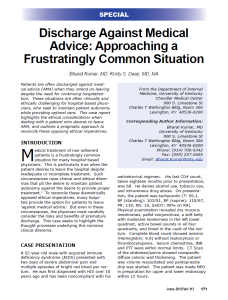
“Discharge Against Medical Advice” – TL;DR

It’s perhaps a little late, but I would like to establish a new feature here on the blog, a TL;DR section for recently published articles.  To those who don’t know, “TL;DR” stands for “Too Long: Didn’t Read.”  In internet-speak, It’s a one or two sentence summary of a story that is worth communicating but whose length may be too intimidating for casual readers.

So here is my first TL;DR (courtesy of twitter):

If you want to read the full article, it can be found here, or on the website of the Journal of the Kentucky Medical Association.

DAMA

The article, though not in the most prestigious or noteworthy of journals, has a very sentimental place in my heart.  It is likely the last manuscript on which I can legitimately write that I am a resident at the University of Kentucky.  Quite fittingly, it also happens to be featured as a special in the last ever issue of the Journal of the Kentucky Medical Association.  C’est la vie, I suppose.