
Category Archives: Medical Journalism

Rheumatic Diseases aren’t just First World Problems – a TL;DR

Last night, I took a long walk to clear my mind and gazed up at the night sky. On this moonless night, I saw the Milky Way in all its glory, something I only rarely get to appreciate nowadays. Seeing Orion, the Big Dipper, and the other constellations triggered some very fond memories of family vacations that we spent in India. I remember my grandfather pointing above to connect the dots and telling me the mythic stories of how they came to be in their positions in the night sky.

It also reminded me about how small our world is. The same stars that I viewed from the foothills of the Himalayas twenty-some-odd years ago are the same ones I can see from the plains of Midwestern America. And the same diseases that I see in clinic – Rheumatoid Arthritis and Systemic Lupus Erythematosus to name just two – are the same that afflict those throughout India and the third world.

But for some reason, we completely forget about those in the developing world who have these diseases. For some reason, we think that only the immune systems of those people in the First World are susceptible to dysregulation, and that, because we have effective treatments to induce remission in many of these patients, that poorly controlled disease is a thing of the past.

It’s not. The agents we use to induce remission are largely either unavailable or inappropriate in large swathes of the developing world. It’s unreasonable to use some of our potent immunosuppressants in areas where latent tuberculosis is rife. Monitoring for toxicity is often impossible, and so patients are left to suffer on their own.

This editorial is meant to help bring these issues to the forefront, and to highlight that our work, as rheumatologists and rheumatologists-in-training, is far from done. Immunologic and musculoskeletal diseases bear a disproportionately high rate of morbidity in these areas. It’s easy to get caught up in the excitement of new medications and diagnostic techniques, but we must never forget that we are also obligated to treat those with the greatest need.
“Maintaining Sharp Focus on A Grainy Film” – TL;DR

There are some phrases completely unknown to the general public that medical professionals would instantly recognize.  One of them is “miliary pattern,” which has essentially become a euphemism for disseminated TB.  But the miliary pattern that is seen on chest x-rays and CT scans is not synonymous with disseminated tuberculosis.  Instead, it can be seen in plenty of other situations, like the one we describe in this article, published in the BMJ Case Reports.

This article has actually been in publication-purgatory for about a year or so, but I’m glad that it’s finally out in print.

Sneak Peak: Anton Chekhov’s Case Report

Things are rather humdrum here in Iowa, not that I’m complaining.  Life continues, with new colleagues, new challenges, and new clinical responsibilities as a second year fellow.

Fotunately, in the past few days, because of the lull in activity, I have had a chance to write.  Without giving too much away, I would like to provide a sneak peak for the next essay I intend on drafting:

There are few physicians who have read the works of Anton Chekhov.  Even fewer have heard of his gun.  But still, Checkhov’s gun hangs unobstrusively in the background of every case report in medical literature today, waiting patiently to be discharged at a moment’s notice.  It can be considered both the greatest strength of the modern case report, as well as its most notable bane.  To those who do not know, …

Well, that’s how it starts.  I’m not sure how it will end though, but I suppose that is the fun of writing.

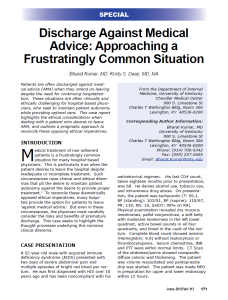
“Discharge Against Medical Advice” – TL;DR

It’s perhaps a little late, but I would like to establish a new feature here on the blog, a TL;DR section for recently published articles.  To those who don’t know, “TL;DR” stands for “Too Long: Didn’t Read.”  In internet-speak, It’s a one or two sentence summary of a story that is worth communicating but whose length may be too intimidating for casual readers.

So here is my first TL;DR (courtesy of twitter):

If you want to read the full article, it can be found here, or on the website of the Journal of the Kentucky Medical Association.

DAMA

The article, though not in the most prestigious or noteworthy of journals, has a very sentimental place in my heart.  It is likely the last manuscript on which I can legitimately write that I am a resident at the University of Kentucky.  Quite fittingly, it also happens to be featured as a special in the last ever issue of the Journal of the Kentucky Medical Association.  C’est la vie, I suppose.